Container Loading Math: How Many Memory Foam Pillows Fit in a 40HQ
A practical container loading guide for memory foam pillow importers: loose vs vacuum-compressed counts in a 40HQ, CBM math, and how packing choice changes landed cost.
Introduction
For any importer, the moment a quotation turns into a purchase order the question stops being "what does it cost per piece" and becomes "how many can I actually fit, and what does that do to my landed cost". Container loading math is where memory foam pillow programs win or lose margin, because ocean freight is sold on volume, not weight. This guide gives buyers a working model for how many pillows fit in a 40HQ, why vacuum compression changes the answer by multiples, and how to read a supplier's loading plan before committing.
Start With the Box, Not the Pillow
A standard 40-foot high-cube container (40HQ) gives you roughly 76–78 cubic meters of internal volume and a payload limit near 28 tons. Most pillow shipments hit the volume wall long before the weight wall: a compressed pillow weighs a few hundred grams, so even 30,000 of them is only a few tons. That means your real constraint is CBM, and small changes in how the pillow is packed move the count dramatically.
- Loose, pillow-style units are bulky: a typical 60×40×12 cm pillow occupies close to 0.029 CBM each before carton and void space.
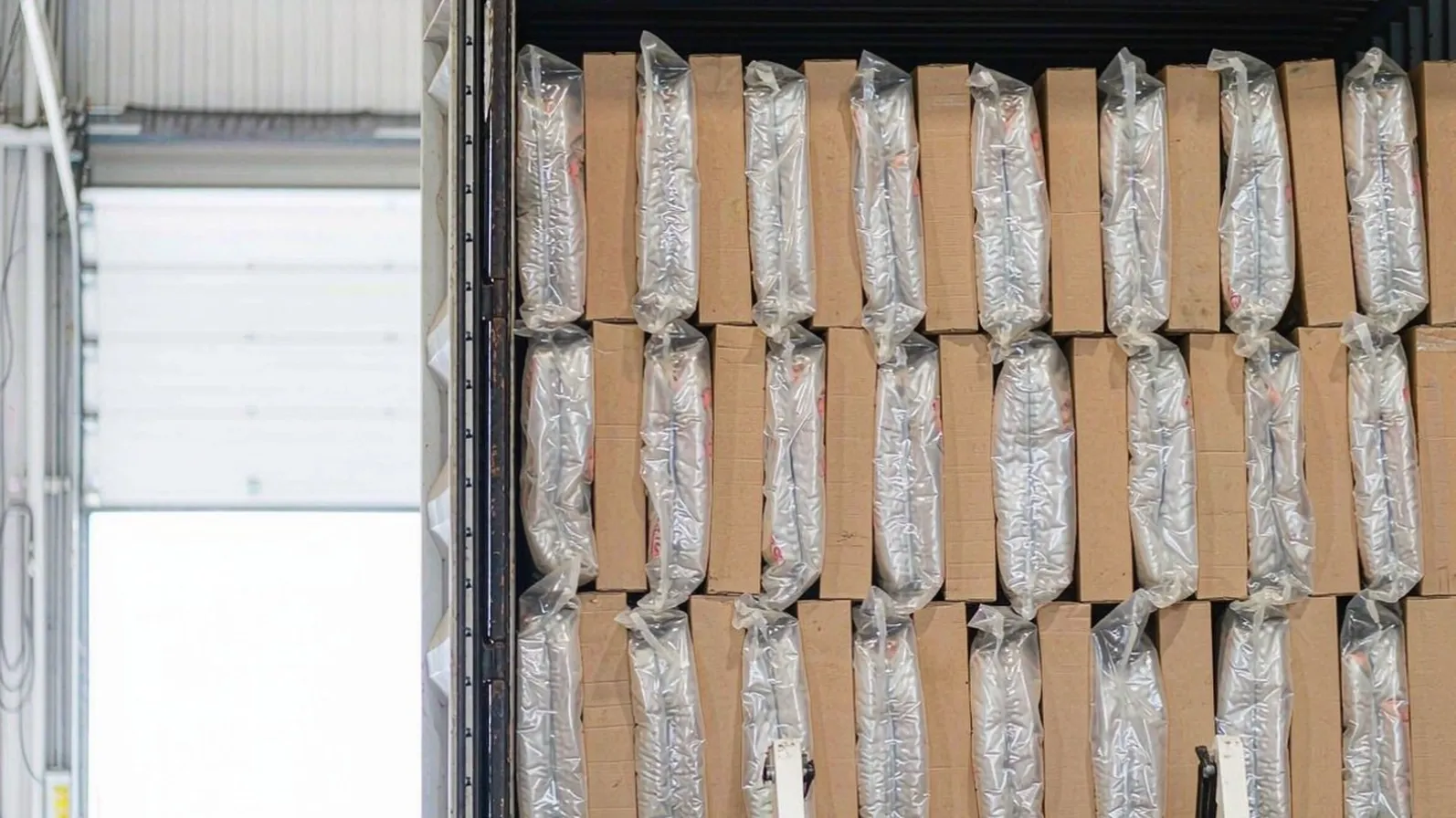
- Vacuum-compressed and roll-packed units collapse to roughly a quarter of that volume, often under 0.008 CBM each.
- Carton stacking efficiency and the unavoidable void between boxes usually trims the theoretical maximum by 10–15%.
The Loose-Load Baseline
If you ship pillows loose in cartons, a 40HQ typically holds somewhere in the 7,000–10,000 unit range depending on pillow size and carton packing. That number surprises first-time buyers because the container looks half empty by weight. For a memory foam pillow program built on presentation and quick shelf stocking, loose loading is simplest, but it leaves most of your freight budget on the table.
What Vacuum Compression Unlocks
This is the single biggest lever in container loading math. By removing air and roll-packing, the same 40HQ that held ~8,000 loose units can approach 28,000–34,000 compressed units. The exact count depends on the post-compression roll diameter and carton footprint, but the order of magnitude is what matters for budgeting: compression can cut per-unit freight by 60–70%.
- Lower CBM per unit directly lowers the freight cost allocated to each pillow.
- Compression also reduces carton damage from shifting, since dense rolls pack tighter.
- The trade-off is recovery time: compressed foam needs hours to re-loft, which affects your downstream fulfillment lead time.
Tie this into your quotation early. Ask every supplier for both loose and compressed CBM so you compare landed cost, not just ex-works price. The vacuum compression packing choice belongs in the first quote, not as a later optimization.
Build the Loading Plan Yourself
Do not accept a supplier's "about 30,000 units" as planning data. Build a one-line model so you can sanity-check any loading plan they send:
- Units per carton × cartons per layer × layers per container = total units.
- Verify the carton footprint against the 40HQ floor (about 2.35 m wide × 12 m long usable).
- Confirm the carton height stack against the ~2.69 m internal height, leaving clearance for the door and weight distribution.
When the math does not close, the gap is usually void space or an optimistic carton count. A trustworthy supplier will hand you the carton dimensions and let you recompute.
Pillow Size Drives the Count
/posts/how-memory-foam-pillows-are-made and overall size are the physical inputs to the count. A low-loft travel pillow and a thick 15 cm bed pillow occupy very different volumes even at the same compressed diameter. When you standardize a range, model each SKU separately rather than averaging, because the tallest SKU sets the stack height for the whole layer.
For mixed-SKU programs, load by height band: keep similarly sized cartons on the same layer so you do not waste the vertical space the way a careless mixed stack does. The memory foam pillow size and loft spec you choose upstream is therefore also a logistics decision, not just a comfort one.
Watch the Calendar, Not Just the Cube
A perfectly packed 40HQ still misses the season if it ships late. Chinese New Year shuts coastal factories for two to four weeks, and bookings compress in the weeks before. Plan container loading against the factory holiday calendar, not just against cubic meters, and build buffer for the pre-holiday booking squeeze at the port.
Buyers who align PO timing with the lunar new year window avoid the classic trap: a great freight rate on a container that arrives after the selling season ends.
Protect the Count With MOQ and Lot Planning
Minimum order quantities interact with container loading in two ways. First, a low MOQ per SKU lets you fill a container with more variety, which is good for testing markets but can raise carton complexity. Second, volume MOQ tiers usually unlock better unit pricing that offsets freight. Model your MOQ tiers against a full-container target so you are not leaving price on the table to hit a round number of units.
Red Flags in a Loading Quote
Most loading problems are visible in the first document if you know what to look for.
- A count with no carton dimensions attached — you cannot verify it, so treat it as a guess.
- "About" or "up to" figures with no stack diagram — optimism, not planning.
- Loose and compressed numbers that are identical — the supplier may not actually offer compression.
- Weight-per-carton omitted — you cannot confirm you are under the 28-ton payload.
Conclusion & Next Step
Container loading math for memory foam pillows is straightforward once you separate volume from weight and put compression on the table. Model each SKU, demand both loose and compressed CBM, and align your booking with the factory calendar. Buyers who plan the cube this way consistently import more units per dollar and fewer surprises per container.
Talk to our sourcing team on WhatsApp +86 137 7374 7840 for a vacuum-compression freight quote, carton dimensions, and MOQ tiers tailored to your market.


