How Memory Foam Pillows Are Made: A Factory Walkthrough
Step-by-step walkthrough of memory foam pillow manufacturing — raw foam pouring, mould cutting, cover sewing, ILD verification, AQL inspection, and container packing for B2B buyers evaluating a memory
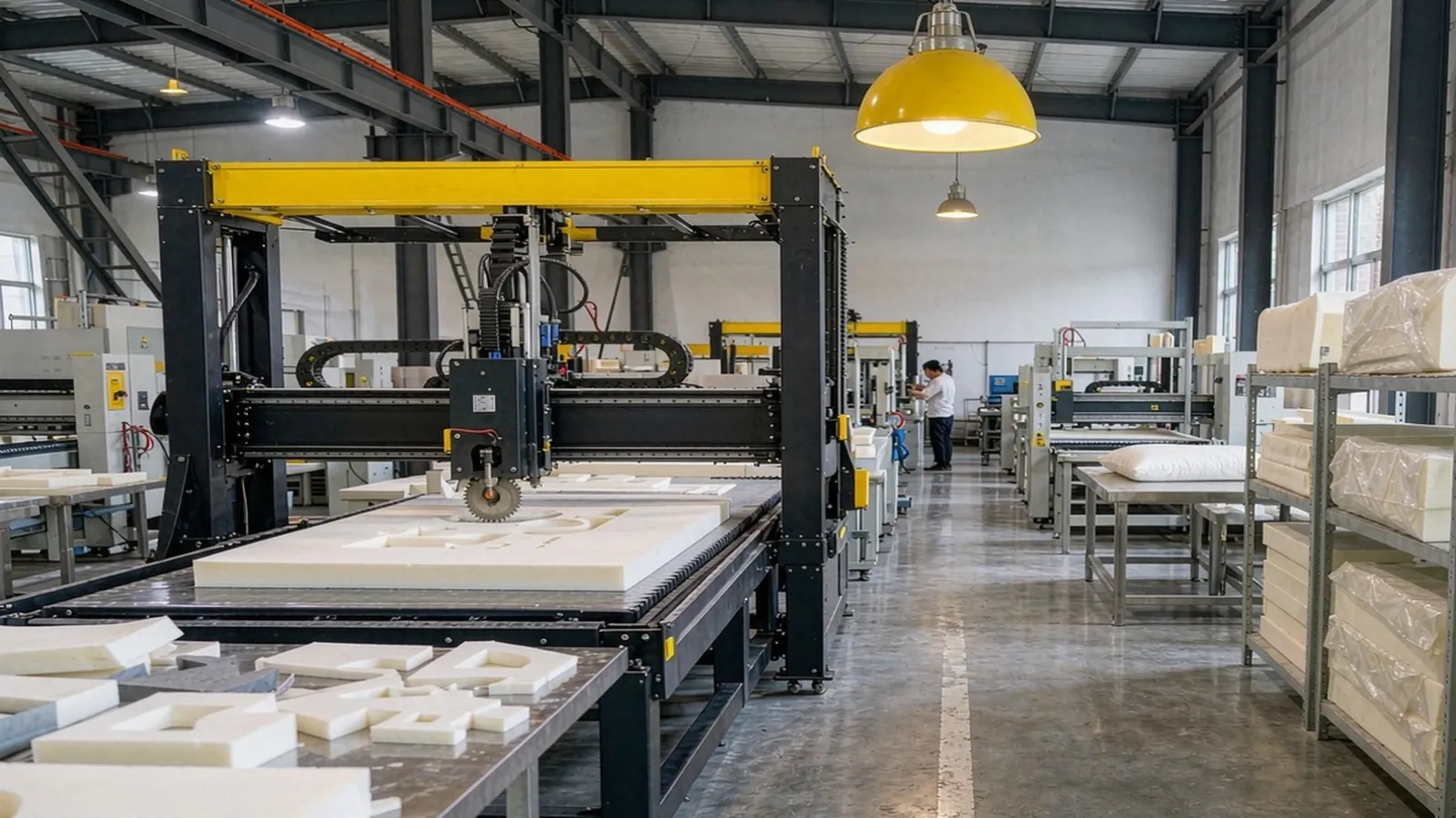
Walking a memory foam pillow production line answers more questions than any catalogue. A buyer who has seen foam poured, cut, sewn, tested, and packed knows where the risks hide — and which supplier claims actually mean something. This walkthrough covers what a real factory looks like, from raw-material intake to the moment a finished pillow leaves the loading dock.
Why the manufacturing line matters when you choose a memory foam pillow manufacturer
Two factories can quote the same spec and deliver very different products. The difference is almost never the brochure — it is what happens between the door and the loading bay. Process discipline determines whether density holds, whether dye lots match, and whether a pre-shipment inspection ever finds the defects it is supposed to find. When you evaluate a memory foam pillow manufacturer, the line tells the truth.
Ask to see the line before you sign anything. A factory that walks you through every step is also a factory that lets you put cameras in for pilot runs. A factory that hides the line usually hides the chemistry.
Raw-material inspection: polyols, isocyanates, additives
Memory foam starts as two liquid streams — a polyol blend and an isocyanate — plus a controlled additive package (catalysts, surfactants, blowing agents). Each tanker arrives with a Certificate of Analysis. The factory checks water content, hydroxyl number, acid value, and viscosity before any drum is plumbed into the line. Anything outside spec gets quarantined in a side bay, not blended in quietly.
Additive accuracy is the keystone. A 0.2 percent drift in catalyst can shift cell structure, raise or lower indentation load deflection, and change recovery behaviour — all without changing the visible colour of the foam. Most line-level defects trace back to a skipped raw-material check six hours earlier.
Foam pouring and curing: where chemistry becomes product
The two streams meet in a high-pressure mixing head, then pour into an open mould or a continuous conveyor pour. Reaction begins within seconds; the foam rises like bread, holds its shape, and must cure under controlled temperature and humidity for 12 to 24 hours depending on formulation. Cutting before the cure finishes leaves internal stresses that show up later as splits or pillow loft drift.
Most quality problems are not cutting problems — they are cure problems. Walk past the curing room and ask the supervisor how they log humidity. If the answer is “we do not log it”, keep walking.
Mould design and CNC contour cutting
Once the bun or mould is cured, the foam is demoulded and conditioned. CNC contour cutting does the geometric work: the cervical curve of an ergonomic pillow, the loft profile of a gusseted side sleeper, the rolled edge of a hospitality pillow. Tooling cost amortises across volume, so a low-MOQ custom shape is expensive per piece — discuss tooling ownership early.
Contour consistency depends on foam density and feed speed. A factory that cuts memory foam at the wrong density will hit tool deflection and produce a pillow whose centre is 8 mm taller than the edge. Buyers catch this with a five-point height gauge at the pre-shipment inspection.
Cover fabric: cutting, sewing, and assembly
Cover fabric typically arrives on roll from a separate mill. The factory cuts panels on a CNC cloth cutter (small runs use manual), serges or overlocks the seams, attaches the zipper or envelope closure, and slips the foam core into the cover. Sewing defects — skipped stitches, uneven tension, raw-edge exposure — are the most common AQL failures in pillow programmes.
For programmes where colour consistency matters (hotel chains, retail brands), fabric is cut and sewn lot by lot, with shade verification against an approved standard before sewing begins. Skip that step and you will see bed shipped, not bedding shipped.
ILD verification: the number that actually defines comfort
After assembly each pillow lot is sampled for indentation load deflection (ILD) on a calibrated indentation tester. ILD is the force, in newtons, needed to compress a foam sample by 25 percent of its thickness under standard conditions. Two foams with the same density can have very different ILDs, and ILD is what your customer feels when their head hits the pillow.
A factory serious about its results will pass dimensional and ILD checks at the pre-shipment inspection, not only at incoming foam inspection. Document the ILD acceptance window in your spec sheet. “Soft” and “medium” are not specs — “ILD 10–14 N at 25 percent deflection, ASTM D3574 Test M” is a spec.
Pre-shipment inspection: AQL sampling on the finished pillow
A pre-shipment inspection pulls a sample from the packed lot per an AQL table (commonly ISO 2859-1, AQL 2.5 for major defects and 4.0 for minor — your spec can tighten this). Inspectors check dimensions, weight, cover stitching, zipper function, label accuracy, carton count, and a destructive ILD spot check on a small number of cores. Failed lots are reworked or set aside, not blended into passing pallets.
Insist on witnessing the AQL draw at least once. The number of sample units, how they are chosen, and which defects count as “major” versus “minor” are negotiable items. Get them on the spec page before the first PO, not after the first claim.
Vacuum compression packaging and container load planning
Finished pillows are poly-bagged, optionally vacuum-compressed and roll-packed (a 40 HQ container can take roughly 5,800 roll-packed standard pillows versus around 1,600 loose-packed — a meaningful CBM saving on ocean freight), stacked into export-grade cartons, palletised, and stretch-wrapped. Load planning then maximises cartons per pallet and pallets per container without crushing the bottom layers.
If you operate dual sourcing or a second qualified supplier strategy, agree the same packaging spec across both factories before you start parallel production. Mismatched carton sizes destroy container maths and leave you paying for air.
Questions to ask before you place the first PO
A short checklist for the first factory visit — bring it on a tablet, not in your head:
- Where is the raw-material COA checked, and by whom, and is the log auditable?
- How is cure humidity logged, and what is the corrective action if it drifts?
- What ILD range do you commit to per SKU, per lot, and which standard do you test against?
- What AQL do you sample at pre-shipment inspection, and which are major versus minor defects?
- How do you control colour consistency across dye lots, and what is the claim path if a hotel chain rejects a shade?
- What is your policy on dual sourcing — same tooling, same fabric source, same cover construction?
A memory foam pillow manufacturer that answers these on the floor is a memory foam pillow manufacturer that ships to spec. One that cannot is one you find out about six claims later.
Talk to the factory that walks you through the line
If you want a B2B memory foam pillow partner who will walk you through the line, let your team put eyes on a pilot run, and lock the spec before tooling, we would like to hear from you. Send the spec, your target ILD and pillow loft, your volume window, and your destination market to +86 137 7374 7840 and we will arrange a factory visit, a sample round, and a quotation aligned to your programme.


